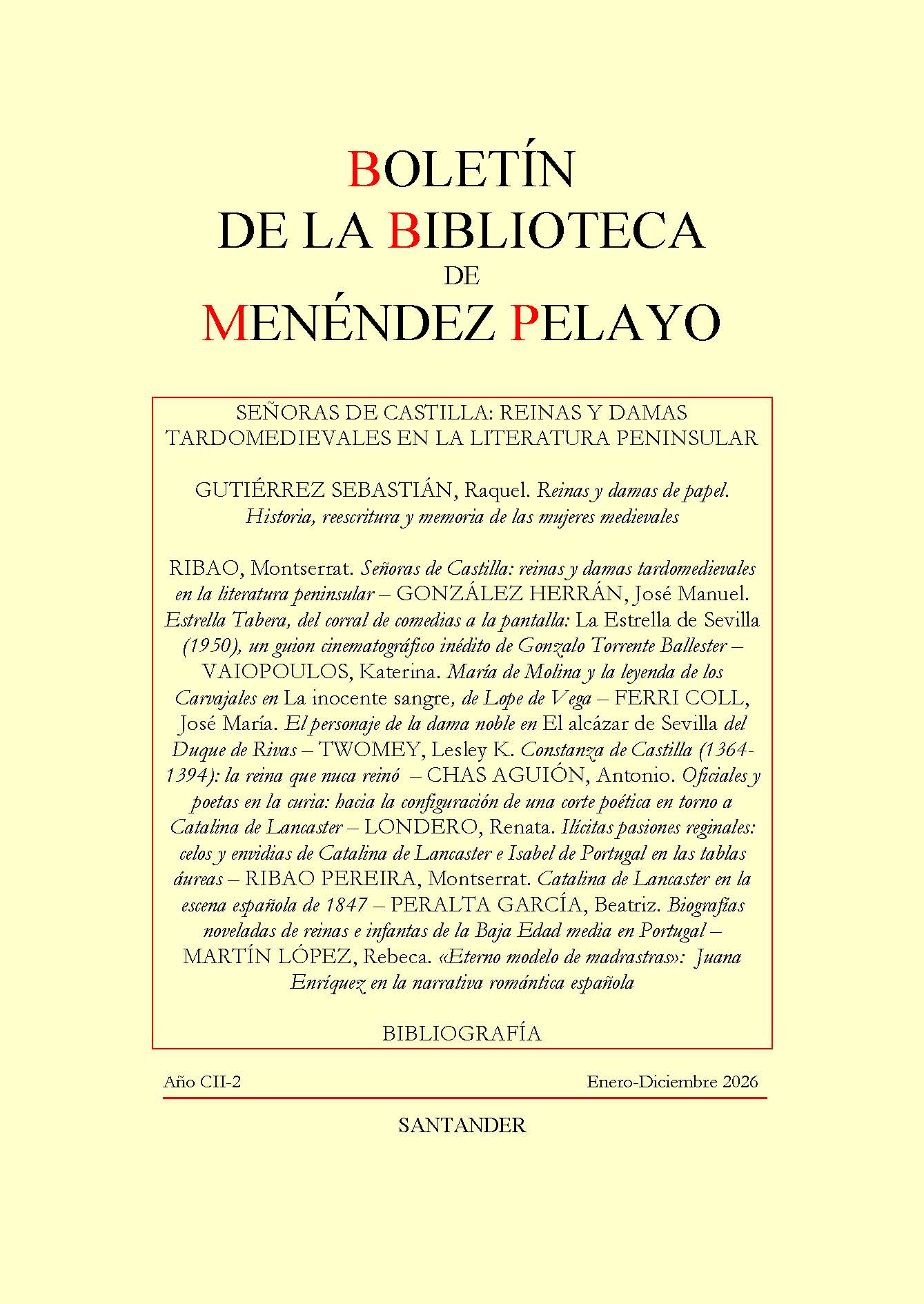
María de Molina and the legend of the Carvajales in La inocente sangre, by Lope de Vega
DOI:
https://doi.org/10.55422/bbmp.1126Keywords:
Queens. Theater. Chronicles. Power.Abstract
Queen María de Molina (c. 1264-1321) was a fundamental figure in the post-Alfonsine era, one of the most complex periods in the history of Castile, officially during the reigns of her husband, her son, and her grandson. Her governing abilities and the authority she acquired not only guaranteed her political prominence but also favored her rapid transformation into a literary character. On the 17th century stages, the work that most celebrated her was La prudencia en la mujer, by Tirso de Molina, a comedia that has already aroused considerable critical interest. However, María de Molina also appears in the first act of La inocente sangre, by Lope de Vega. This is a less known and studied work, focusing not on the queen but on the legend of the Carvajales; nevertheless, despite her reduced stage presence, the character of María de Molina is significant and reveals how the role of this lady of Castile continued to be interpreted and valued.
Downloads
Publication Facts
Reviewer profiles N/A
Author statements
Indexed in
- Editor & editorial board
- profiles
- Academic society
- Sociedad Menéndez Pelayo
- Publisher
- Sociedad Menéndez Pelayo

To learn about these publication facts, click 
PF is maintained by the Public Knowledge Project
Global Statistics ℹ️
|
191
Views
|
349
Downloads
|
|
540
Total
|
|
Published
How to Cite
Issue
Section
License
Copyright (c) 2026 Katerina Vaiopoulos

This work is licensed under a Creative Commons Attribution-NonCommercial 4.0 International License.