Cymbeline en the 1900 y pico: Internal debate surrounding feminism and masks of identity in the theater of Alfonsina Storni
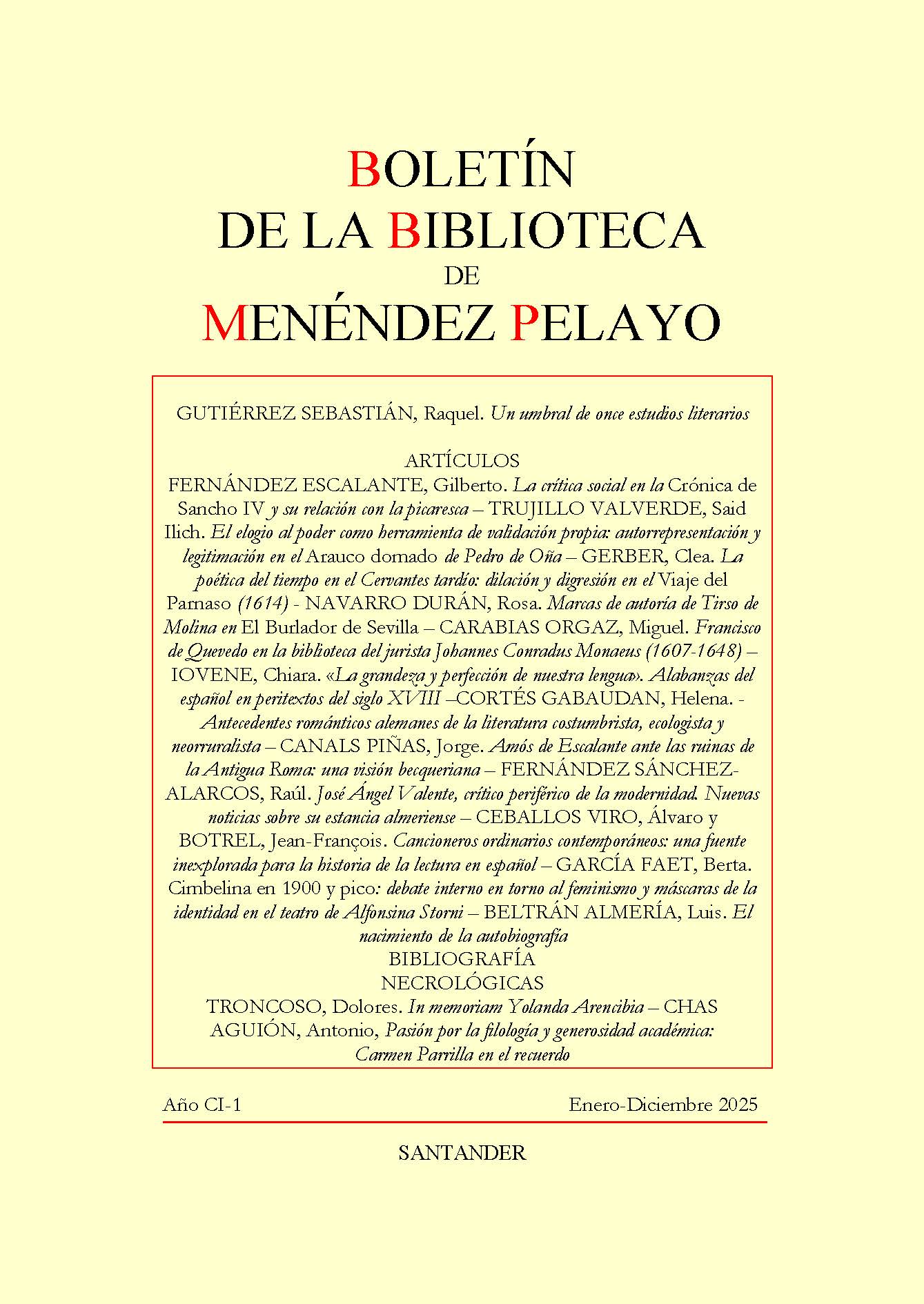
Cimbelina en 1900 y pico: debate interno en torno al feminismo y máscaras de la identidad en el teatro de Alfonsina Storni
DOI:
https://doi.org/10.55422/bbmp.1143Keywords:
reescritura, feminismo, disonancia, ironíaAbstract
Cimbelina en 1900 y pico, one of Alfonsina Storni’s two plays included in Dos farsas pirotécnicas (1932), is a critical rewriting of Shakespeare’s Cymbeline (1610). I focus on the dissonance this play brings to the feminist question: just as in her poetry there is a tension between the acceptance of sexist stereotypes and their resistance, here too there is sociosexual norm and transgression. Although it has been read as a purely feminist piece, I suggest that the characterization of the protagonist, María Elena, and other authorial marks (such as the annotations) suggest a self-debate that questions the violence of gender stereotypes but goes beyond that topic and delves into some intricate existentialist questions avant la lettre.
Downloads
Publication Facts
Reviewer profiles N/A
Author statements
Indexed in
- Editor & editorial board
- profiles
- Academic society
- Sociedad Menéndez Pelayo
- Publisher
- Sociedad Menéndez Pelayo

To learn about these publication facts, click 
PF is maintained by the Public Knowledge Project
Global Statistics ℹ️
|
190
Views
|
147
Downloads
|
|
337
Total
|
|
References
BARRANCOS, Dora. (2010) Mujeres en la sociedad argentina. Una historia de cinco siglos. Buenos Aires: Sudamericana.
BEAUVOIR, Simone de (2017). El segundo sexo. Madrid: Cátedra.
CALLE, Leandro, y VASSALLO, Jacqueline. (2016) Alfonsina Storni. Literatura y feminismo en la Argentina de los años 20. Editorial Universitaria Villa María.
CASTILLO, Jorge Luis. (1998) «Delmira Agustini O El Modernismo Subversivo». Chasqui. Vol. 27. No. 2. 70-84. DOI: https://doi.org/10.2307/29741438
<http://www.jstor.org/stable/29741438>
GARZÓN-ARRABAL, Cecilia. (2008) El teatro de Alfonsina Storni: Feminismo e Innovación. Dissertation. Chapel Hill.
<https://cdr.lib.unc.edu/.../uuid:798f0eec-f3da-4ab4-a332-6c780cd2f33a>
GEASLER TITIEV, Janice. (1980) «Alfonsina Storni's ‘Poemas de amor’: Submissive Woman, Liberated Poet». Journal of Spanish Studies: Twentieth Century. Vol. 8. No. 3. 279-292. <http://www.jstor.org/stable/27740950>
HAKIM, CATHERINE. (2011) Erotic Capital: The Power of Attraction in the Boardroom and in the Bedroom. Basic Books.
JÓDAR PEINADO, María Pilar. (2016) Metateatro español: estudio del concepto y de su presencia en cien textos teatrales de los siglos XX y XXI. Tesis doctoral. Madrid: Academia de las Artes Escénicas y UNIR.
KUHNHEIM, Jill. (2008). «The Poetics of Form: Three Twentieth-Century Spanish American Poets and the Sonnet». Hispanic Review. Vol. 76. No. 4. 387-411. DOI: https://doi.org/10.1353/hir.0.0027
LUDMER, Josefina. (1985). «Las tretas del débil». La sartén por el mango. Puerto Rico: Ediciones Huracán.
<https://literaturaanimada.wordpress.com/wp-content/uploads/2014/03/ludmer-tretas-del-dc3a9bil.pdf>
MASIELLO, Francine. (1992) Between Civilization & Barbarism: Women, Nation, and Literary Culture in Modern Argentina. University of Nebraska Press.
< https://archive.org/details/betweencivilizat0000masi/page/n5/mode/2up>
MICHELMAN, Stephen. (2010) The A to Z of Existentialism de Michelman. Scarecrow Press.
MORELLO-FROSCH, Marta. «Alfonsina Storni: The Tradition of the Feminine Subject». Women, Culture, and Politics in Latin America. Ed. Bergmann et al. University of California Press. 90-104. DOI: https://doi.org/10.2307/jj.5233057.10
MURILLO, Edwin. (2023) Latin America and Existentialism: A Pan-American Literary History (1864-1938). Le Vergne: University of Wales Press.
MUSCHIETTI, Delfina. (1989) «Las mujeres que escriben: Aquel reino anhelado, el reino del amor». Nuevo Texto Crítico. Año II. Nº. 4. 79-102. DOI: https://doi.org/10.1353/ntc.1989.0026
<https://muse.jhu.edu/article/489541>
PHILLIPS. Rachel. (1975) Alfonsina Storni: From Poetess to Poet. London: Tamesis Books.
PIEROPAN, María D. (1993) «Alfonsina Storni y Clara Lair: De la mujer posmodernista a la mujer DOI: https://doi.org/10.2307/343881
moderna». Hispania. Vol. 76. No. 4. 672-682.
<http://www.jstor.org/stable/343881>
PRIETO, Julio. (1998) «Cimbelina en 1900 y pico: las tácticas de la (re)escritura en el teatro de Alfonsina Storni». Latin American Theatre Review. Vol. 32. No. 1. 25-50.
<https://journals.ku.edu/latr/article/view/1224/1199>
RUIZ PÉREZ, Ignacio. (2008) «Contra-escrituras: Delmira Agustini, Alfonsina Storni y la subversión del modernismo». Revista Hispánica Moderna. Año 61. No. 2. 183-196. <http://www.jstor.org/stable/40647488> DOI: https://doi.org/10.1353/rhm.2008.0004
SALGADO, María A. (1992) «Alfonsina Storni in her self-portraits: the woman and the poet». Confluencia. Vol. 7. No. 2. 37-46.
<http://www.jstor.org/stable/27922094>
SALOMONE, Alicia. (2009) «Escritura, imagen y política en dos poetas argentinas: Alfonsina Storni y Alicia Genovese». Concepción. No. 499. 135-148. DOI: https://doi.org/10.4067/S0718-04622009000100008
STORNI, Alfonsina. (1932) Dos farsas pirotécnicas. Buenos Aires: Cooperativa Editorial.
STORNI, Alfonsina. (2017) Poesía. Prólogo: Delfina Muschietti. Buenos Aires: Losada.
UNRUH, Vicky. «Alfonsina Storni’s Misfits: A Critical Refashioning of Poetisa Aesthetics». Performing Women and Modern Literary Culture in Latin America. University of Texas Press. 30-51.
ZAPATA DE ASTON, Arcea Fabiola. (2002) Fuerza erótica y liberación: Un nuevo sujeto femenino en la poesía de Delmira Agustini, Juana de Ibarbourou y Alfonsina Storni. Dissertation. University of Iowa.
Downloads
Published
How to Cite
Issue
Section
License
Copyright (c) 2025 Berta García Faet

This work is licensed under a Creative Commons Attribution-NonCommercial 4.0 International License.