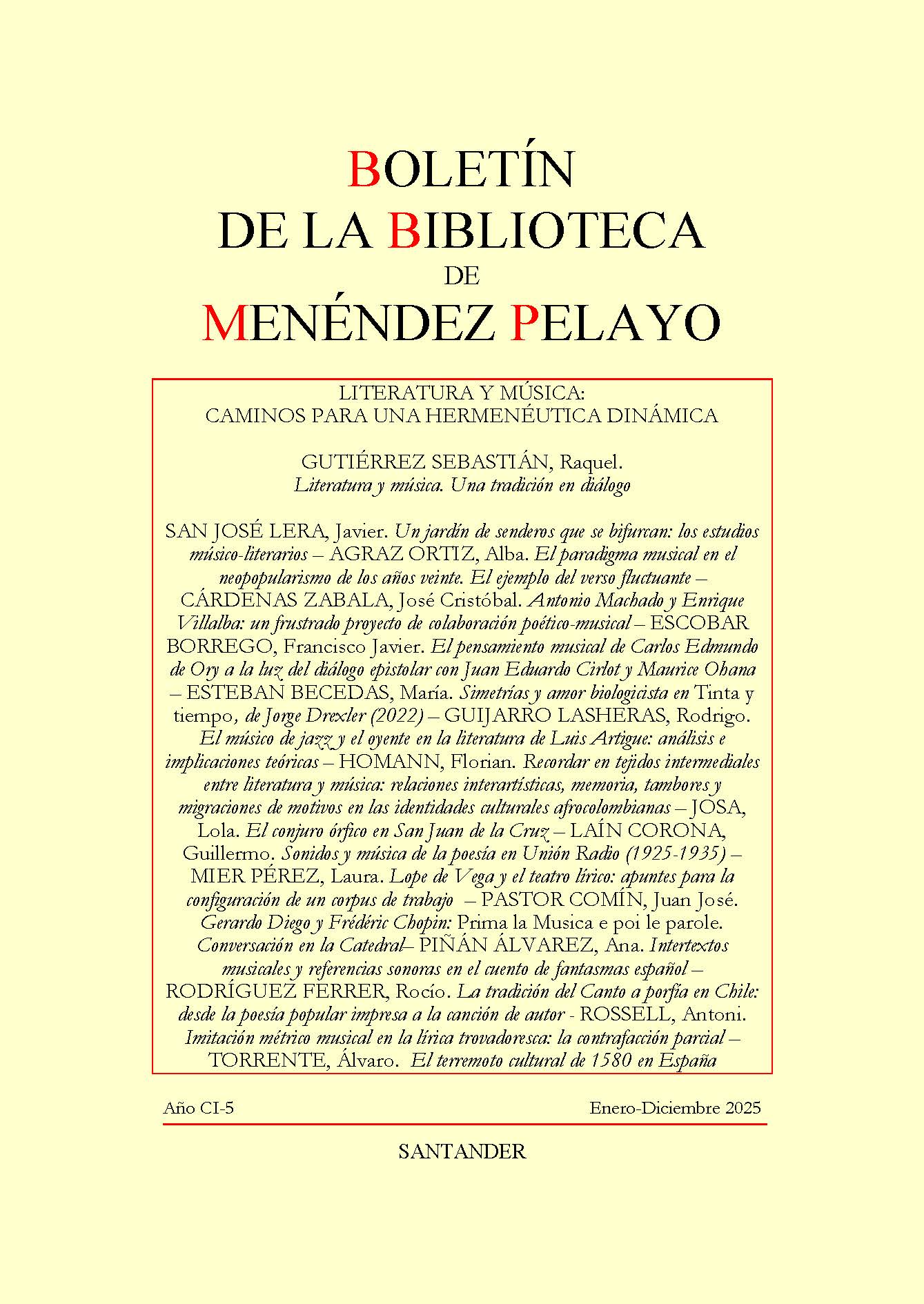
Vol. 101 No. 5 (2025): Literature and music: paths to a dynamic hermeneutics
Since its founding in 1919, the Boletín de la Biblioteca de Menéndez Pelayo has been a privileged space for the study of Spanish literature in its historical, aesthetic, and cultural dimensions. Within this framework, the relationship between literature and music has occupied a constant, though never exclusive, place, articulated around a conception of the literary that recognizes its oral origin, its temporal nature, and its dependence on rhythmic and sonic forms. This perspective directly refers to the thought of Marcelino Menéndez Pelayo and, especially, to his Historia de las ideas estéticas en España, a work in which the scholar from Santander repeatedly emphasized the kinship between poetry and music as arts that develop over time and seek an internal harmony of their elements.
Menéndez Pelayo's conceptual framework, inscribed in a classicist and normative aesthetic ideal, presents, from a contemporary perspective, evident limitations for addressing aesthetics marked by dissonance, fragmentation, or sonic experimentation. However, his reflection opened a horizon of analysis that allowed us to consider literature as an aesthetic phenomenon embedded in a broad cultural tradition and in dialogue with other arts. This horizon has accompanied, explicitly or implicitly, the trajectory of the BBMP, which has successfully extended it and subjected it to critical review for over a century.
It is within this context that the monographic volume Literature and music: paths to a dynamic hermeneutics (CI-5, 2025) is situated, constituting a significant contribution to the intellectual trajectory of the Boletín de la Biblioteca de Menéndez Pelayo and, at the same time, a critical update of its theoretical foundations. The fifteen works it comprises traverse, from an intermedial and interdisciplinary perspective, a broad historical and cultural arc that ranges from troubadour lyric poetry and sung poetry of the medieval and Golden Age traditions to contemporary literature, encompassing neopopularism, the avant-garde, the Silver Age, and modern forms of mediated orality. This volume explores the relationship between word and music through studies on metrical-musical imitation and counterfaction, on poetry and songbooks, on the structural presence of music in modern lyric poetry, and through analyses of operatic librettos, opera, and musical theater as literary genres. Alongside these historical and formal approaches, it includes works dedicated to poetry in dialogue with flamenco and jazz, to the interactions between literature, radio, and the cultural industry, to the role of music in fantastic narratives, and to Afro-diasporic traditions, sound performance, and the politics of memory. Taken together, the collected studies demonstrate how music can function as a structuring principle of the literary text and as a situated cultural practice, linked to processes of transmission, identity, and aesthetic experience, reaffirming the relevance and critical productivity of the dialogue between literature and music in contemporary literary studies.
Published:
2025-12-30